
A Research Instrument, Not Yet a Mature Commercial Product
ADSP™ — Art-Derived Strategic Policy — is the fourth instrument in EURAN's Art-Derived Systems Suite. It is presented here as a research instrument under development.
Unlike ADSM™ — Art to Space, ADDM™ — Art to Design and ADMM™ — Art to Media, ADSP™ cannot be treated as a simple transfer from artwork to object, space or image.
Policy concerns behaviours, rules, responsibilities, protocols, public language and institutional decisions. For this reason, ADSP™ must be handled with more caution. It does not claim that artworks produce laws, diplomacy, security decisions or public administration.
ADSP™ does not use art as decoration, symbolism or political commentary. It studies the structural DNA of an artwork and translates it into abstract behavioural principles that may inform policy-level thinking.
What Art to Policy Means
In EURAN terms, Art to Policy means the following:
An artwork is analysed as a system of relations. Its composition, hierarchy, balance, movement, tension, rhythm, voids, thresholds, figure-ground relations, centrality, plurality and conflict-resolution logic are extracted.
These extracted characteristics are translated into behavioural principles. A composition may suggest deliberation, transparency, coordination, restraint, plurality, protection, hospitality, memory, continuity, justice, balance or distributed authority.
Those principles may then inform institutional protocols, civic programmes, public calls, cultural charters, governance behaviours or communication frameworks.
Boundary: ADSP™ does not replace legal, diplomatic, political, administrative, security, military, insurance or operational expertise. It is a cultural-intelligence method for producing institutional imagination and disciplined public language.
The ADSP™ Translation Chain
1. Artwork Selection
A specific artwork is selected because its formal and relational logic is relevant to the institutional question being studied.
2. DNA Extraction
The artwork is analysed for composition, hierarchy, rhythm, thresholds, conflicts, balances, voids, centres, margins, movement and symbolic architecture.
3. Behavioural Translation
The formal DNA is translated into behavioural principles: how people, institutions, groups or stakeholders could relate, deliberate, protect, coordinate or decide.
4. Policy-Level Structuring
The behavioural principles are organized into a cultural policy framework, charter, public call, protocol, civic programme or institutional posture.
5. Public Instrument
The result becomes a usable cultural instrument: a note, declaration, briefing, scenario, programme, code, workshop or position paper.
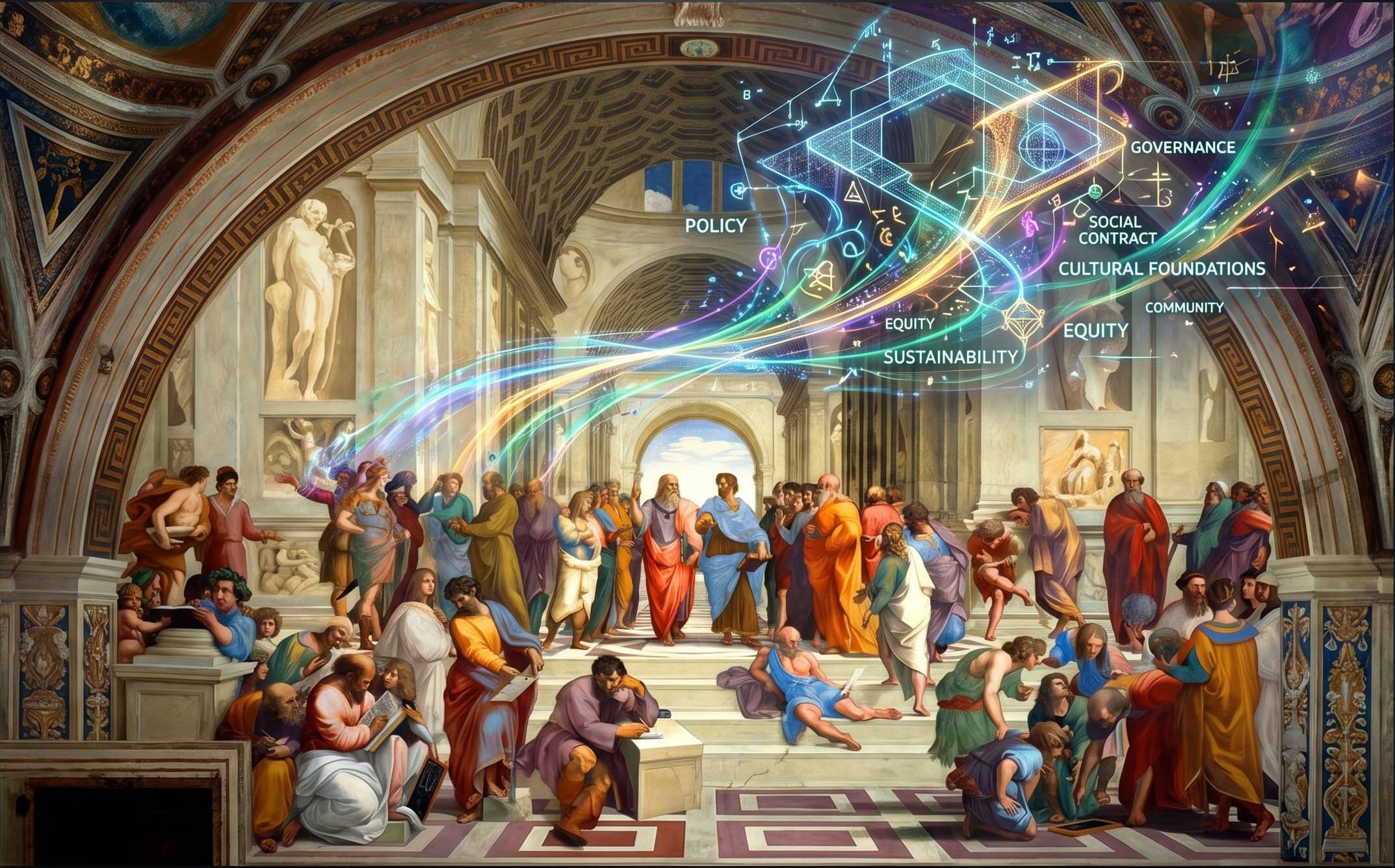
Example: Raphael's The School of Athens
The hero image refers to Raphael's The School of Athens. ADSP™ would not use this artwork as a vague symbol of wisdom. It would analyse its structural DNA.
Artwork DNA
Plurality of figures, organized dialogue, central open axis, coexistence of schools of thought, architecture as rational container, movement toward a shared civic space.
Behavioural Principles
Deliberation, intellectual plurality, visible disagreement without rupture, ordered openness, institutional hospitality to different doctrines, knowledge as a public space.
Policy-Level Translation
Design of civic forums, institutional dialogue protocols, educational programmes, cultural assemblies, advisory councils or public-debate frameworks.
Possible Output
A cultural charter for a university, museum, city forum, foundation, maritime conference or public institution seeking disciplined plural dialogue.
This is the difference between ADSP™ and ordinary political commentary: the policy-level idea is generated from the analysed structure of an artwork.
Hormuz Is Not Presented as a Full ADSP™ Case
The Hormuz safe-passage appeal currently belongs primarily to EURAN's Marine Cultural Intelligence, Shipping Embassies and the cultural reading of strategic maritime passages.
It should not be presented as a mature Art to Policy case unless a specific artwork is selected, analysed and used to generate the behavioural logic of the appeal.
ADSP™ may contribute later to the Hormuz theme if EURAN develops an artwork-based policy study on civilian passage, non-combatant dignity, institutional restraint or maritime humanitarian language.
For the current Posidonia communication, the Hormuz page should therefore be described as a maritime cultural-intelligence appeal, not as a full ADSP™ application.
→ Ships Are Not Belligerents — Hormuz Cultural Safe Passage Appeal
Where ADSP™ Could Become Operational
ADSP™ may become useful where institutions need cultural imagination before creating frameworks of behaviour, dialogue or public posture.
- cultural policy and civic institutions;
- universities, museums, academies and foundations;
- public dialogue protocols and civic forums;
- institutional hospitality, mediation and plural deliberation;
- heritage-based governance principles;
- cultural charters for cities, ports, exhibitions or public places;
- corporate public-position frameworks where cultural language matters.
Art-Derived Systems Suite
ADSP™ is the fourth instrument in the Art-Derived Systems Suite:
Discuss an ADSP™ Research Case
EURAN may develop ADSP™ only through precise artwork-based case studies. The first valid step is to select an artwork, define the institutional question, and test whether the artwork's structural DNA can generate useful behavioural principles.