

When Culture Fails to Become Capital
Across luxury real estate, hospitality, and maritime sectors, cultural and experiential decisions are often treated as aesthetic layers rather than strategic infrastructure. Assets can look refined, yet underperform in pricing power, valuation resilience, and long-term differentiation.
CCPI™ exists to make this gap visible: where identity, authorship, and experience are not yet functioning as capital multipliers.
What CCPI™ Measures
CCPI™ evaluates assets across eleven authored dimensions, each scored on a 0–10 anchor-based scale and weighted per sector. The result is a 0–100 index that reframes culture and experience as measurable capital, not decoration.
The methodology is partially transparent: dimension names and philosophy are visible; the weight matrix, anchors, and aggregation logic remain proprietary to EURAN.
The 11 CCPI™ Dimensions
- Identity Coherence: Clarity, unity, and recognizability of the authored identity across architecture, interiors, and operations.
- Experiential Sequencing: The structured progression of spatial, sensory, and emotional moments across the full user journey.
- Cultural Depth: Authentic, context-aware cultural logic embedded in the asset, beyond decorative gestures.
- Conceptual Originality: Non-derivative authorship and resistance to imitation; a unique conceptual system.
- Emotional Resonance: Capacity to generate emotional attachment, memory anchors, and repeat engagement.
- Spatial & Functional Integrity: Alignment between spatial logic, circulation, zoning, and functional efficiency.
- Operational Robustness: Long-term operability, maintenance logic, staff flow, and lifecycle durability.
- Economic Leverage: The degree to which cultural and experiential quality convert into pricing power and yield.
- Strategic Defensibility: Barriers to imitation, IP logic, and competitive insulation created by the system.
- Ecosystem Integration: Coherence with adjacent luxury sectors and portfolio-level identity.
- Cultural Asset Activation: The degree to which art, design, heritage, collections, programming and other cultural assets are actively integrated into the experience and identity, rather than remaining isolated decorative elements.
Deep Dive: Cultural & Creative Performance Index
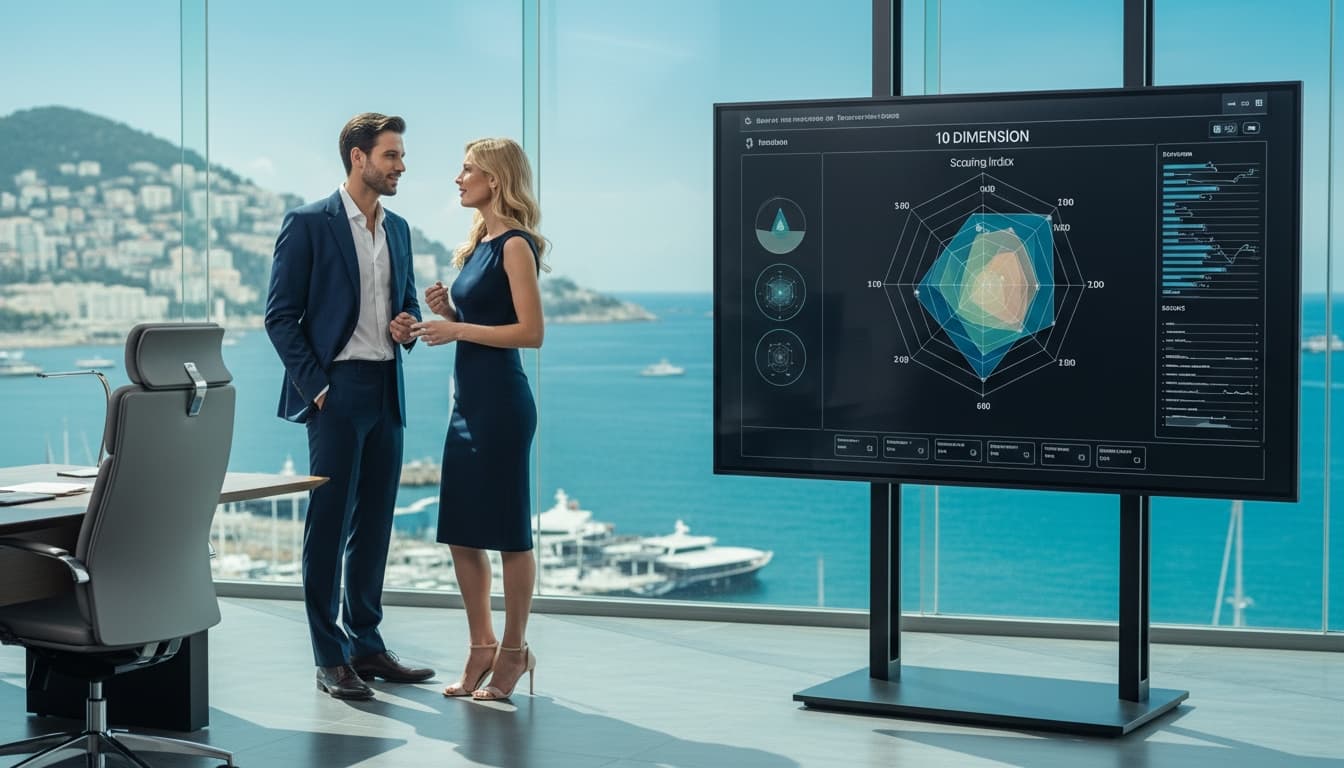
Deep Dive Summary — Cultural & Creative Performance Index
The Cultural and Creative Performance Index CCPI™ is a sovereign diagnostic engine designed to translate "soft" cultural and experiential metrics into hard capital allocation logic. It measures ultra‑high‑value assets across 11 distinct dimensions to determine three specific outcomes: pricing power, valuation resilience, and strategic defensibility.
The system utilizes a sector‑adjusted weight matrix to calibrate scoring for Cruise, Marinas, Hotels, Mega‑Yachts, and Real Estate. It reframes culture, identity, and experience not as decorative expenses, but as primary infrastructure and capital multipliers that dictate financial yield and long-term asset value.
CCPI functions alongside the Cultural Stability Intelligence CSI and Space Perceived Value Index SPVI to provide a complete diagnostic overview of an environment’s health, ensuring that authored identity is successfully converted into measurable economic leverage.
Transcript Availability:
The full English transcript of this Executive Briefing was generated via NotebookLM and is available upon request.
Contact: management@euran.com.
Interpreting a CCPI™ Profile
CCPI™ does not label assets as “good” or “bad.” It reveals how cultural, experiential, spatial, and operational decisions are functioning as value drivers or value leaks.
- Lower profiles: Indicate structural weaknesses in identity, experience, or operations that undermine value.
- Mid-range profiles: Indicate functional assets that lack defensibility or authored distinctiveness.
- Higher profiles: Indicate authored, coherent, strategically aligned assets with stronger insulation and leverage.
The exact thresholds and calibration logic remain proprietary and are only discussed in confidential briefings.
Scoring & Sector Logic
Each dimension is scored 0–10 using authored anchors. Scores are then weighted per sector using a 100-point matrix, reflecting where value is structurally created in:
Sector Focus:
Cruise, Marinas, Hotels & Resorts, Mega-Yachts, and Real Estate.
Engine Logic:
Anchor-based scoring, sector-adjusted weighting, red-flag caps, and expert overrides.
Evaluator Independence: For selected benchmark and field-audit applications, EURAN may deploy multiple independent AI evaluators under the same CCPI™ architecture. Their identities are secondary to the method: evaluators work independently, and EURAN performs quality control and triangulation only after the individual evaluations are complete.
What a CCPI™ Engagement Produces
A CCPI™ diagnostic is not a marketing label. It is a structured, sovereign assessment designed for owners, boards, and portfolio-level decision makers.
- CCPI™ Profile: A 0–100 index across eleven dimensions, calibrated per sector.
- Strategic Reading: Interpretation of where culture and experience are creating or leaking value.
- Priority Focus Areas: Identification of the most critical dimensions to address.
Detailed methodology, scoring sheets, and internal logic remain confidential and are only discussed under NDA.
CCPI™ in Action
CCPI™ is applied selectively to global-scale entities and maritime assets where culture, identity, authorship and institutional presence can be read as strategic value.
- EURAN Financial 500 CCPI™ Rankings: a cultural audit of global power, mapping authorship and coherence against pure financial scale.
- Greek Shipping CCPI™ Index: an anonymized cultural-visibility index for Greek and Greek-related commercial shipping, connecting fleet identity, legacy and strategic maritime presence.
- EURAN Global Superyacht CCPI™ Index: a cultural reading of superyachts as authored assets, not only as luxury objects.
- CCPI™ — Monaco Yacht Show 2025 Audit: the preserved MYS25 cultural-field baseline, now tested retrospectively against specialist media and expert commentary.
- CCPI™ — Monaco Yacht Show 2026 Audit: completed MYS26 field audit using independent AI scoring, quality control and triangulation.
From Culture to Capital
CCPI™ is built on an uncompromising thesis: culture, authorship, and experience are not decorative—they are infrastructure. The index exposes where identity is functioning as a capital multiplier and where strategic failures are silently destroying value.
For boards and sovereign investors, CCPI™ reframes “soft” cultural questions into hard allocation logic.
Board-Level Briefing
CCPI™ is deployed selectively across high-value assets and portfolios. A concise 20-minute strategic briefing introduces the CCPI™ logic, the eleven dimensions, and the sector-adjusted model, and explores whether a diagnostic is appropriate for your context.