EURAN EUROPEAN ART NETWORKS · STRATEGIC BRIEF

The Hour of Greece — BOOT Düsseldorf 2026

A distributed cultural activation revealing Greece as a coherent maritime identity.

Strategic edition for clients and partners · Last updated: 24 January 2026

Cultural Strategy Marinas & Yachting Exhibitions European Maritime Identity

Executive summary

The Hour of Greece is a light, distributed cultural activation designed for BOOT Düsseldorf 2026. It allows exhibitors with a connection to Greece to signal that link through a shared visual identity and a voluntary “Greek Hour” at their stand, without infrastructure, pavilions, or formal commitments.

For BOOT, marinas, tourism authorities, and private partners, the activation offers a low-friction way to test a coherent Greek maritime narrative inside the fair: Greece as a unified cultural presence rather than a fragmented set of stands.

This strategic brief outlines the logic, benefits, and possible extensions of The Hour of Greece as a pilot for broader Art Marinas and maritime culture initiatives in the coming years.

Context and opportunity

Greece is one of the world’s most important yachting and cruising destinations, a leading charter region in the Mediterranean, and a reference point for maritime culture. Yet at major international fairs, its presence often appears fragmented: multiple stands, multiple actors, no single cultural thread.

The Hour of Greece proposes a different approach: instead of building a pavilion, it creates a symbolic, synchronized presence across existing stands. Exhibitors who count Greece as part of their story can choose to make that visible — together, at the same fair, under a shared cultural sign.

Core concept

At its simplest, The Hour of Greece is:

  • a shared visual identity (sign/poster) for exhibitors connected to Greece
  • a voluntary “Greek Hour” during which those exhibitors are available to discuss their Greek activities
  • a collective editorial recap documenting this presence after the fair

No infrastructure is required. No exhibitor is asked to change their stand design. The activation overlays a cultural narrative on top of the existing BOOT ecosystem.

Key strategic benefits

For BOOT Düsseldorf

  • Showcases BOOT as a platform for cultural as well as commercial innovation.
  • Highlights the Mediterranean and Greek dimension of the fair without additional infrastructure.
  • Creates a story that media can easily understand and relay.

For Greek-related exhibitors

  • Signals their connection to Greece in a clear, elegant, non-promotional way.
  • Offers editorial visibility in the post-fair recap.
  • Positions them within a broader narrative of Greek maritime culture.

For marinas & institutions

  • Provides a pilot framework for future Art Marinas and cultural strategies.
  • Tests messaging and partnerships with minimal risk and cost.
  • Opens a path toward more structured initiatives in 2027 and beyond.

Participation model

1. Eligibility

Any exhibitor at BOOT Düsseldorf 2026 with a meaningful connection to Greece may participate, including:

  • marinas and ports with Greek locations
  • charter and brokerage companies offering Greek itineraries
  • shipyards, designers, and service providers working with Greek clients
  • equipment and lifestyle brands with Greek production or design
  • tourism and destination actors focused on Greece

2. Symbolic gesture at the stand

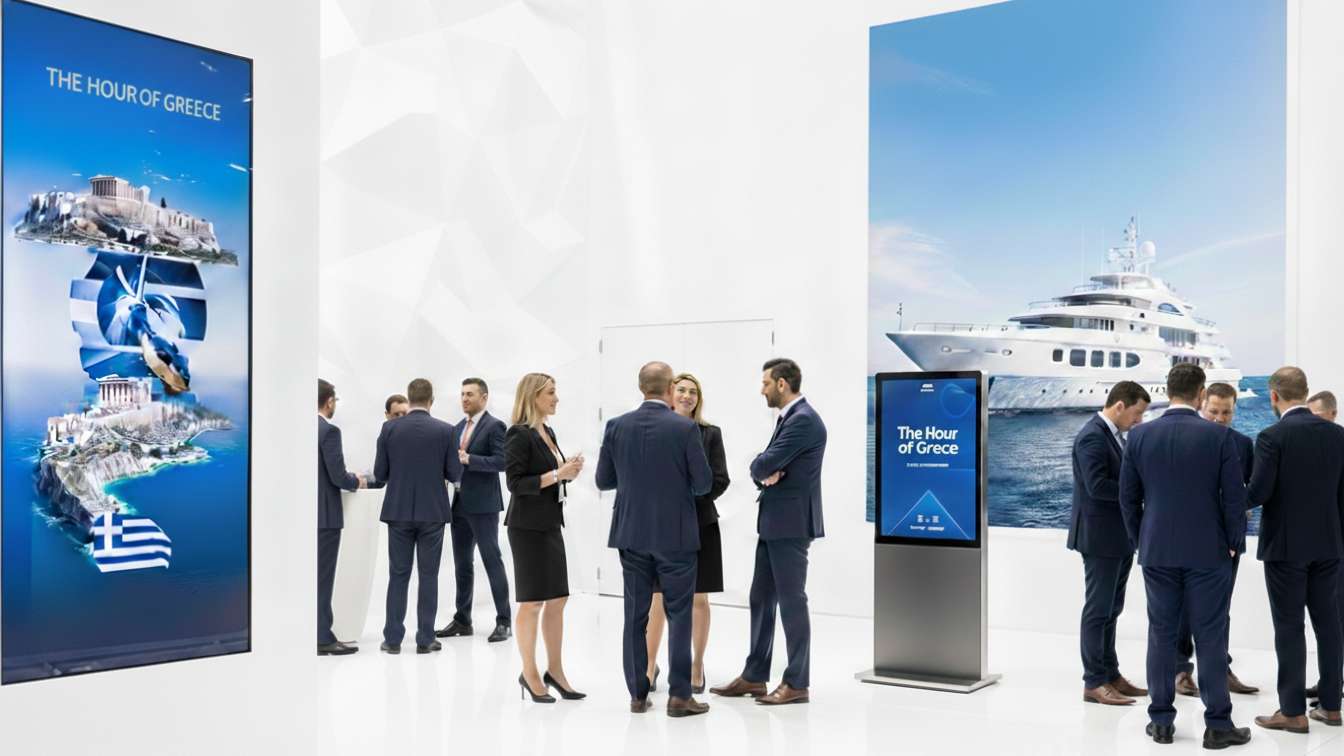
Each participating exhibitor receives a digital sign/poster with The Hour of Greece visual identity. Displaying it at the stand signals that visitors are welcome to ask specifically about the company’s Greek activities.

3. The “Greek Hour”

Exhibitors may choose a 60-minute window during the fair to act as their own “Greek Hour”. During that time, at least one team member is available to present the company’s Greek-related offers, projects, or collaborations.

4. Documentation and recap

Each participant is invited to send a high-resolution photo of their stand with the sign visible. These images, along with short descriptions of their Greek connection, form the basis of an editorial recap distributed after the fair.

Cultural identity video

The Hour of Greece — Cultural Identity Video (2026 Edition)

A short, one-minute video can accompany the activation as a cultural identity asset. It is designed to be:

  • poetic rather than promotional
  • focused on sea, light, architecture, and hospitality
  • usable in presentations, briefings, and selected partner channels

Key narrative elements include:

  • Greece as more than a destination — a maritime culture and origin point.
  • World-class hospitality framed within Mediterranean elegance.
  • Yachts and seascapes presented as part of a larger cultural epic.
  • Historic architecture and landscapes as the “canvas” where sea and sky meet history.

For selected partners (Level 2: clients and institutional collaborators), the video can be adapted with:

  • company name and logo in the closing frame
  • co-branded usage in internal briefings or private presentations

Public usage remains carefully curated to preserve the cultural, non-commercial tone of The Hour of Greece.

Deep Dive Dialogues — Extended Reflections

A series of three in‑depth video dialogues expanding on the cultural, strategic, and institutional logic behind The Hour of Greece. Each conversation is based on the January 15, 2026 strategic dossier and offers a different linguistic and cultural entry point into the project.

Deep Dive — English

A reflective conversation outlining the core narrative, strategic intent, and long‑term vision of The Hour of Greece for international partners.

Deep Dive — Greek

A Greek‑language exploration of the project’s cultural foundations, its relevance for Greek marinas, institutions, and the wider maritime ecosystem.

Deep Dive — German

A German‑language dialogue tailored to BOOT Düsseldorf’s central European context, addressing cultural positioning, visitor experience, and institutional collaboration.

Applied scenarios

Scenario 1 — BOOT + Greek marinas

  • Greek marinas and marina groups participate collectively in The Hour of Greece.
  • Each stand hosts its own Greek Hour, with a shared narrative about marinas as cultural gateways.
  • Post-fair recap positions Greek marinas as a coherent network within the BOOT ecosystem.

Scenario 2 — Charter & brokerage

  • Charter companies highlight Greek itineraries during their Greek Hour.
  • Clients encounter Greece as a curated cultural experience, not just a route on a map.
  • Editorial recap showcases the diversity of Greek cruising experiences represented at BOOT.

Scenario 3 — Institutional partners

  • Tourism and maritime institutions observe the pilot as a low-risk cultural test.
  • Results inform future decisions on Art Marinas, national narratives, and fair presence.
  • Potential evolution into a broader Mediterranean or thematic activation in later years.

Relation to other EURAN work

The Hour of Greece can serve as an entry point into broader EURAN frameworks, such as:

  • Art Marinas — marinas as open-air cultural infrastructures.
  • Waterfront aesthetics and architecture — linking built environment and maritime identity.
  • Curatorial activations at international fairs — light, distributed cultural gestures.

Dedicated pages and dossiers (e.g., on waterfront aesthetics and art-driven architecture) can be linked from this strategic brief for partners who wish to explore deeper collaborations.

Contact and next steps

For BOOT Düsseldorf, marinas, institutions, or private partners interested in exploring The Hour of Greece as a pilot or as part of a broader cultural strategy:

Contact:
EURAN European Art Networks
Email: management@euran.com

Upon request, a more detailed dossier can be shared under appropriate conditions, including extended scenarios, governance options, and integration with long-term Art Marinas strategies.